Legacy Leadership Series · Volume I

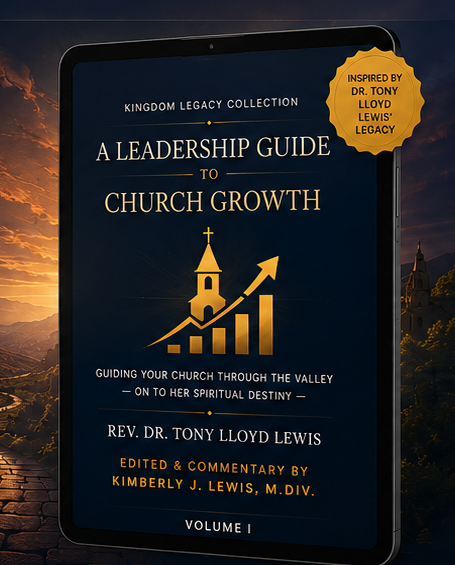
A Leadership Guide to Church Growth

Guiding Your Church Through the Valley —On to Her Spiritual Destiny

Author
Rev. Dr. Tony Lloyd Lewis
Editor & Commentary
Kimberly J. Lewis, M.Div.

A digital leadership academy built from Rev. Dr. Tony Lloyd Lewis' timeless church leadership principles. Explore biblical frameworks, dialectical analysis, practical leadership applications, implementation playbooks, and ministry resources designed for pastors, elders, church boards, and ministry leaders.

  • Biblically Grounded
  • Proven Frameworks
  • Leadership Playbooks
  • Ministry Applications
  • Downloadable Resources
A Leadership Guide to Church Growth — Rev. Dr. Tony Lloyd Lewis, edited & commentary by Kimberly J. Lewis, M.Div.
Section One

About This Resource

Rev. Dr. Tony L. Lewis wrote A Leadership Guide to Church Growth out of a pastor's conviction that the church does not grow accidentally and does not stagnate accidentally either. Behind every healthy congregation stands a clear mission, a Spirit-given vision, and leaders who refuse to choose between spiritual depth and organizational discipline.

The guide was forged in the valley — in seasons where the church was tested by transition, conflict, and the temptation to settle. Dr. Lewis insists that the valley is not the obstacle to spiritual destiny; it is the road to it. His framework therefore weaves together pastoral theology, governance, evangelism, discipleship, and team formation into one integrated leadership philosophy.

Mission, vision, and leadership are not interchangeable terms. Mission is what Christ has commanded the church to be and do; it is fixed. Vision is how a particular congregation, in a particular season, obeys that mission; it can and must adapt. Leadership is the stewardship that holds the two together so the people of God advance instead of drift.

Healthy growth requires both spiritual formation and organizational development. A church that prays without planning withers under its own zeal; a church that plans without praying produces structure without souls. Dr. Lewis trains leaders to do both — to disciple deeply and to build wisely.

More than two decades after these principles were first taught, the guide remains startlingly relevant. The post-pandemic church, the multi-generational congregation, the bi-vocational pastor, the rebuilding deacon board — all are still asking the questions this guide was written to answer.
Section Two

Leadership Framework Overview

Ten interlocking commitments that, together, form Dr. Lewis's leadership framework for guiding a church through the valley on to her spiritual destiny.

01

The First Members-Ministers

Every member is a minister.

Growth begins when the priesthood of all believers stops being a doctrine and becomes a practice. The first members-ministers are not the staff — they are the saints awakened to their calling.

02

Mission

What never changes.

The mission is given by Christ: make disciples, teach obedience, baptize, serve, send. No board vote can amend it. No cultural pressure can retire it.

03

Evangelism

The Gospel goes outside the walls.

Evangelism is the church's heartbeat, not its program. Dr. Lewis insists on Gospel proclamation that is both verbal and incarnational — declared and demonstrated.

04

Discipleship

Converts become workers.

Conversion is the door, not the destination. Discipleship is the pathway from new believer to mature, multiplying member-minister.

05

Vision

What may change.

Vision is the particular shape obedience takes in your city, in your season, with your gifts. Vision must be revisited; mission must not.

06

Kingdom Growth Principles

Depth and breadth together.

Kingdom growth refuses the false choice between numbers and depth. It pursues conversions and character, attendance and accountability, programs and prayer.

07

Corporate Projects

The body acts as one.

Corporate projects are the church-wide initiatives — building, mission, capital, justice — that knit the body together around a shared, costly obedience.

08

Personal Projects

Every member contributes.

Personal projects are the individual assignments — gifts deployed, sacrifices made, neighbors loved — that turn the priesthood of all believers into measurable ministry.

09

Community Transformation

The neighborhood notices.

A truly healthy church changes its zip code. Community transformation is the test of whether spiritual formation has produced sent disciples.

10

Church Leaders' Pledge

Leadership as covenant.

The pledge gathers the framework into a single, signable commitment — a covenant of mission-keeping, vision-honoring, people-serving leadership.

Section Three

Dialectical Leadership Analysis

Applying the Kingdom Sermon Architect methodology: for each major leadership tension in the guide we name the Thesis, the Antithesis, the Scriptural Synthesis, and the practical Transformation it demands of leaders today.

Tension 01

Mission vs. Vision

Thesis

The church is given a fixed mission by Christ — to make disciples of all nations.

Antithesis

Leaders often confuse mission with vision and quietly negotiate the mission to fit cultural preference, financial pressure, or congregational fatigue.

Synthesis

Scripture distinguishes the unchanging commission (Matt. 28:18–20) from the contextual obedience of a particular congregation (Acts 13:1–3). The mission never changes; the vision may.

Transformation

Leaders must annually re-articulate the mission and re-imagine the vision — protecting the first while updating the second.

Tension 02

Numerical Growth vs. Spiritual Health

Thesis

Growth is a biblical expectation — the Lord adds to the church those being saved (Acts 2:47).

Antithesis

Growth is also a biblical temptation — Israel's numerical strength repeatedly outran her spiritual obedience.

Synthesis

The New Testament refuses to separate growth and health: depth produces breadth, and breadth without depth collapses. Both are pursued, neither is idolized.

Transformation

Measure both. Disciple new converts on day one. Plan for the souls God will send, and form them once they arrive.

Tension 03

Clergy-Driven vs. Member-Minister Church

Thesis

God has given pastors and teachers to equip the saints (Eph. 4:11–12).

Antithesis

When the pastor becomes the only minister, the body atrophies and the mission outpaces the staff.

Synthesis

Equipping is not delegation; it is empowerment. The saints do the ministry; the pastor equips, models, and oversees.

Transformation

Build pathways from pew to ministry: identify, train, deploy, and supervise every member-minister.

Tension 04

Faith vs. Reason in Leadership

Thesis

Christian leadership is exercised by faith — trusting God beyond what can be measured.

Antithesis

Christian leadership is also exercised with reason — stewarding people, time, and resources with sober judgment.

Synthesis

"Faith without reason is foolishness; reason without faith is heresy." Dr. Lewis insists they are inseparable disciplines, not competing instincts.

Transformation

Pair every prayer meeting with a planning meeting; pair every plan with prayer. Refuse to lead from either alone.

Tension 05

Serving Tables vs. Ministering the Word

Thesis

The church needs faithful servants for the practical work of the body (Acts 6:1–4).

Antithesis

The church also needs preachers and teachers protected to give themselves to prayer and the Word.

Synthesis

"Many can serve tables, but few can minister the Word." The Acts 6 pattern is not a hierarchy of value — it is a discipline of focus.

Transformation

Audit your senior leaders' calendars. Reassign table-service so Word-ministers can be Word-ministers.

Tension 06

The Valley vs. the Destiny

Thesis

Every congregation is called to a spiritual destiny — fruitful, faithful, multiplying.

Antithesis

Every congregation walks through valleys — conflict, loss, transition, cultural opposition.

Synthesis

The valley is not the detour from destiny; it is the path to it. Psalm 23 leads through the valley, not around it.

Transformation

Lead the people through, not out. Name the valley honestly, walk it pastorally, and keep the destiny in view.

Section Four

The Lewis Leadership Principles

A searchable wisdom collection drawn from the guide. Quote them in sermons, post them in your boardroom, use them in deacon orientations and staff retreats.

Growth
"Growth and size do not solve all problems."

Bigger budgets and fuller pews expose dysfunction faster than they cure it. Health must precede growth, or grow with it.

Mission
"The mission never changes; the vision may change."

Defend the commission like a creed; rewrite the strategy like a sermon.

Faith & Reason
"Faith without reason is foolishness, and reason without faith is heresy."

Spirit-led leadership is also studied, planned, measured leadership — and vice versa.

Leadership
"Many can serve tables, but few can minister the Word."

Protect the calling of the Word-bearer by raising up faithful table-servers.

Member-Ministers
"The mission belongs to every member-minister."

Ministry is not outsourced to staff. The saints are the ministers; the pastors are the equippers.

Vision
"Vision unrevisited becomes nostalgia."

Last year's vision, repeated without prayer, hardens into sentiment.

Leadership
"Lead first by example — in worship, in giving, in study, in service."

What leaders model spreads faster than what leaders mandate.

Discipleship
"Conversion is the door, not the destination."

The aim is not decisions; the aim is disciples who make disciples.

Growth
"Kingdom growth pursues both conversions and character."

Refuse the false choice between attendance and accountability.

Leadership
"Stewardship is a trust, not a perk."

People, time, and money are entrusted to leaders by God, accountable to God.

Mission
"The community must notice the church."

If the neighborhood cannot tell the difference, the congregation has retreated from her assignment.

Vision
"Plan as if it depends on you; pray as if it depends on God — because both are true."

Planning is not unbelief; prayer is not passivity. Both are obedience.

Section Five

Modern Ministry Application

Each topic includes a leadership insight, three implementation lenses (church, staff, ministry team), reflection questions, and action steps to take within 90 days.

Topic

Recovering Mission Clarity

Leadership Insight

Most plateaued churches have not lost their members; they have lost their mission articulation.

Church Application

Preach the mission annually. Print it on every bulletin. Make it the first line of every leadership meeting.

Staff Application

Begin every staff meeting by reading the mission aloud. Tie every job description to it.

Ministry Team

Have each ministry team write a one-sentence statement of how their work serves the mission.

Reflection Questions
  • Can every member of our church state the mission in one sentence?
  • Where in our calendar does the mission get crowded out by maintenance?
  • Which programs continue out of habit rather than mission?
Action Steps
  • Schedule a Mission Sunday this quarter.
  • Audit the top five programs against the mission statement.
  • Sunset or restructure any program that fails the audit.
Topic

Renewing the Vision

Leadership Insight

Vision is not a slogan; it is a season-specific obedience. It must be revisited as the season changes.

Church Application

Host a vision retreat every 3 years; refresh vision communication every 12 months.

Staff Application

Translate the vision into measurable annual goals per department.

Ministry Team

Each ministry team identifies one new initiative that advances the vision in the next 90 days.

Reflection Questions
  • When was our vision last prayerfully revisited?
  • Does our current vision fit our current city and congregation?
  • What would we stop doing if we believed the vision?
Action Steps
  • Calendar a 2-day vision retreat.
  • Draft a 3-year vision narrative.
  • Identify the three corporate projects that will carry the vision.
Topic

Activating Member-Ministers

Leadership Insight

Healthy growth requires a pipeline from pew to ministry — not just from visitor to member.

Church Application

Replace 'join the church' classes with 'become a member-minister' pathways.

Staff Application

Every staff member commits to identifying and raising up two replacements.

Ministry Team

Each team posts open ministry roles publicly and recruits from within the congregation.

Reflection Questions
  • What percentage of our members serve in any ministry capacity?
  • Where are we doing for the saints what we should be equipping the saints to do?
  • Who has been faithful in small things and is ready for more?
Action Steps
  • Launch a Member-Minister discovery class.
  • Map every ministry role and its current vacancies.
  • Pair every new member with a serving mentor in the first 90 days.
Topic

Building a Discipleship Pipeline

Leadership Insight

Discipleship is the pathway from conversion to multiplication. Without a pipeline, churches collect converts but produce no workers.

Church Application

Define five discipleship stages: Seeker → New Believer → Growing Disciple → Servant → Multiplier.

Staff Application

Assign a staff owner to each stage with measurable transitions.

Ministry Team

Every ministry team identifies which stage(s) it serves and reports on movement quarterly.

Reflection Questions
  • Where do new believers go after they pray the prayer?
  • Who is responsible for moving people from one stage to the next?
  • How many multipliers did we produce last year?
Action Steps
  • Draft the five-stage pipeline.
  • Assign owners and metrics.
  • Report movement quarterly to the board.
Topic

Aligning Leadership & Governance

Leadership Insight

Mission drift usually begins not in the pulpit but in the boardroom — when governance forgets the mission it governs.

Church Application

Board orientation should begin with mission, vision, and the Church Leaders' Pledge.

Staff Application

Pastor and lead officers meet quarterly to align preaching, programming, and governance.

Ministry Team

Ministry team leaders attend an annual alignment summit.

Reflection Questions
  • Are our deacons/elders ministers first or managers first?
  • Does our board agenda reflect our mission priorities?
  • Where is governance unintentionally working against the vision?
Action Steps
  • Re-orient the board around the Pledge this year.
  • Restructure board agendas to mission-first.
  • Calendar an annual alignment summit.
Topic

Re-Engaging Evangelism

Leadership Insight

Evangelism cannot be a department; it must be the church's posture. But posture without strategy stays at home.

Church Application

Adopt a neighborhood. Commit to a measurable Gospel presence in it.

Staff Application

Every staff member personally engages two evangelistic relationships this year.

Ministry Team

Every ministry team includes one outward-facing initiative annually.

Reflection Questions
  • Whom did our church share the Gospel with this month?
  • What is our community's most pressing pain — and how are we present in it?
  • Are our front doors and side doors both open to seekers?
Action Steps
  • Map the neighborhood within one mile of the church.
  • Identify three Gospel pain-points to address this year.
  • Train every member-minister in one evangelism conversation framework.
Topic

Leading Through the Valley

Leadership Insight

The valley is not the obstacle to spiritual destiny; it is the road to it. Leaders who deny the valley lose the congregation's trust.

Church Application

Name the valley honestly from the pulpit. Pastor through it; do not paper over it.

Staff Application

Build pastoral and emotional resilience practices into staff rhythms.

Ministry Team

Train team leaders to recognize and respond to grief, conflict, and discouragement.

Reflection Questions
  • What valley is our congregation currently walking through?
  • Where am I tempted to pretend the valley away?
  • Who in our leadership needs pastoral care right now?
Action Steps
  • Schedule a leadership conversation to name the valley.
  • Add pastoral care rhythms for the leadership team.
  • Preach Psalm 23 in its leadership dimensions.
Section Six

Church Growth Playbook

Seven downloadable frameworks that turn the guide into practical implementation tools for leadership retreats, board meetings, and ministry team planning sessions.

Framework

Mission Development Framework

Articulating the unchanging commission for your congregation.

Use this framework with your senior leadership team to draft, refine, or recover your church's mission statement. Mission is what Christ commands; vision is how you obey it.

Framework

Vision Planning Framework

Translating the mission into a season-specific obedience.

Vision answers the question: how will this church, in this season, obey her mission? Use this framework on a vision retreat with board, staff, and ministry leaders.

Framework

Leadership Alignment Framework

Bringing pastor, board, staff, and ministry teams into one direction.

Misalignment is the silent killer of healthy churches. Use this framework at your annual leadership summit.

Framework

Evangelism Strategy Framework

Moving the Gospel from program to posture.

Evangelism is the heartbeat of a healthy church, not one department among many. Use this framework to design a Gospel-saturated strategy.

Framework

Discipleship Planning Framework

Building the pipeline from convert to multiplier.

Conversion is the door, not the destination. Use this framework to design a discipleship pipeline with clear stages, owners, and metrics.

Framework

Community Impact Framework

Becoming a church the neighborhood would miss.

Community transformation tests whether spiritual formation has produced sent disciples. Use this framework to plan visible Kingdom presence.

Framework

Ministry Goal-Setting Framework

Turning vision into measurable annual obedience.

Goals translate vision into action. Use this framework with each ministry team annually.

Section Seven

The Church Leaders' Pledge

A reusable leadership covenant drawn from the guide. Available in three formats — for personal signing, ministry team commitment, and board / officer orientation. Each is exportable as PDF and Word for printing and archiving.

The Pledge

Before God and this congregation, I pledge:

  1. 01I will keep the mission of the Church before me at all times.
  2. 02I will honor the vision God has entrusted to this house and submit my gifts to it.
  3. 03I will lead first by example — in worship, in giving, in study, and in service.
  4. 04I will pursue spiritual formation as the foundation of organizational leadership.
  5. 05I will treat every member as a member-minister, called and gifted by God.
  6. 06I will speak the truth in love and protect the unity of the body.
  7. 07I will steward people, time, and resources as a trust from the Lord.
  8. 08I will welcome correction, pursue wisdom, and lead with humility.
  9. 09I will labor for both spiritual depth and measurable Kingdom growth.
  10. 10I will guide this church through the valley, on to her spiritual destiny.
Personal Leadership Covenant
For individual signing by pastors and ministers.
Ministry Team Commitment Form
For ministry teams to sign together.
Board & Officers Orientation Resource
For deacons, elders, and trustees.
Section Eight

Legacy Impact

Dr. Lewis's leadership philosophy refuses to compartmentalize. Theology, leadership, evangelism, church growth, community transformation, and Kingdom advancement are one inseparable obedience.

Theology

Dr. Lewis's leadership philosophy is theological at its root. He refuses to separate ecclesiology from leadership practice — the doctrine of the church is the foundation of how the church is led.

Leadership

He treats leadership as covenantal stewardship. Authority is exercised under God, modeled before the people, and accountable to the mission Christ has given.

Evangelism

Evangelism is the church's posture, not her program. Dr. Lewis trains leaders to organize the whole congregation toward Gospel proclamation in word and deed.

Church Growth

He insists on numerical and spiritual growth together, refusing the modern false choice between depth and breadth.

Community Transformation

A church that has not changed its neighborhood has not finished its work. His framework binds the congregation to her community as a matter of obedience.

Kingdom Advancement

Every line of the guide pushes toward Kingdom advancement: the increase of Christ's reign through formed disciples, equipped leaders, and faithful churches walking through the valley on to their spiritual destiny.